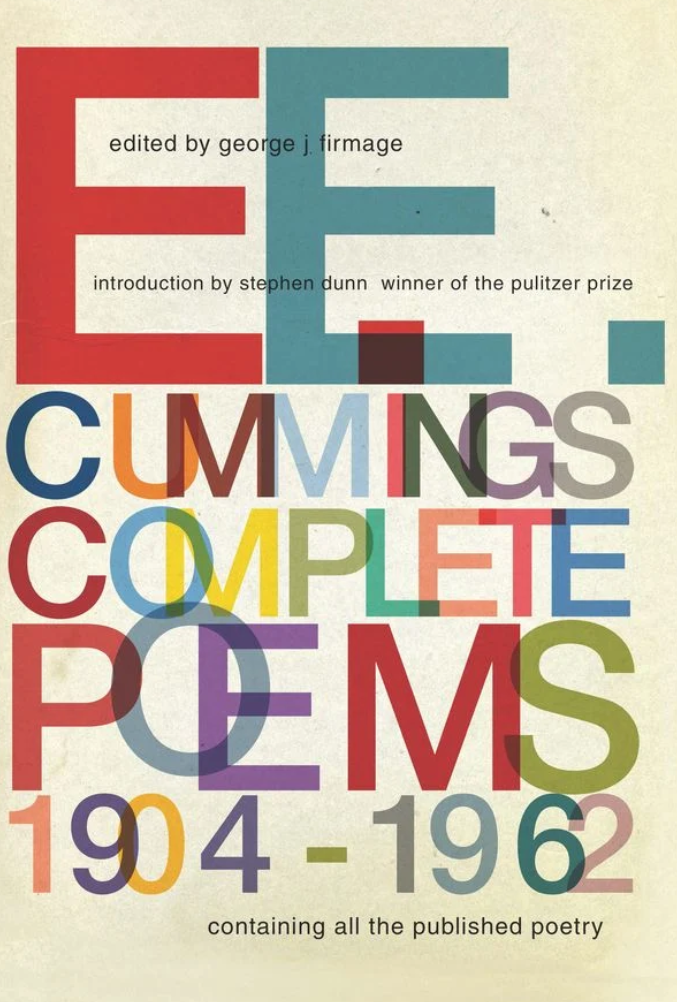
E. E. Cummings
I’m cheating a little with this one. It isn't a book.
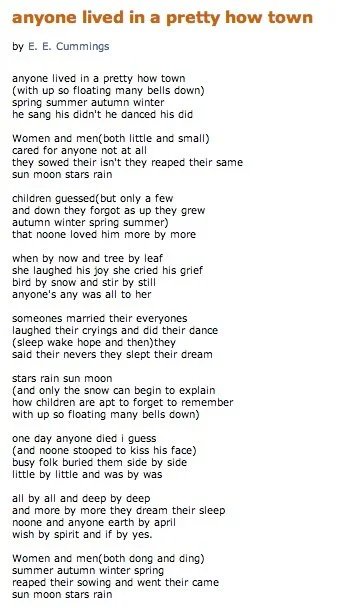
“Anyone lived in a pretty how town” by E. E. Cummings was the first poem I wrote about as an undergraduate English student. Years later, I returned to it for my first academic conference presentation. Somehow, I am still returning to it.
I think this was the poem that first taught me how much language could do when it stopped behaving the way I expected it to.
Cummings disrupts almost everything we are taught a sentence should do. Nouns become people. Familiar words appear in unfamiliar places. Seasons tumble into one another. Meaning isn't handed over easily; you have to participate in making it. And beneath all that linguistic play is a remarkably ordinary story: people live, love, move through the seasons, and die while the world keeps going.
When I first studied the poem, I was fascinated by the puzzle of it. I wanted to understand why the words were where they were and what Cummings was doing with syntax, repetition, and time. I wanted to figure it out.
When I look again, I’m less interested in solving it.
Now, what stays with me is the poem’s attention to an ordinary life. Anyone and noone are simultaneously nobody in particular and all of us. Their love matters enormously to them even as the rest of the town barely notices. A life does not have to be extraordinary to be worthy of poetry.
That idea has never left me.
Maybe the poems that change us aren't always the ones we finally understand.
Maybe they're the ones we never finish reading.