The following is adapted from a speech I gave at Voices of Feminism on March 29, 2023 in Fort Wayne, Indiana.
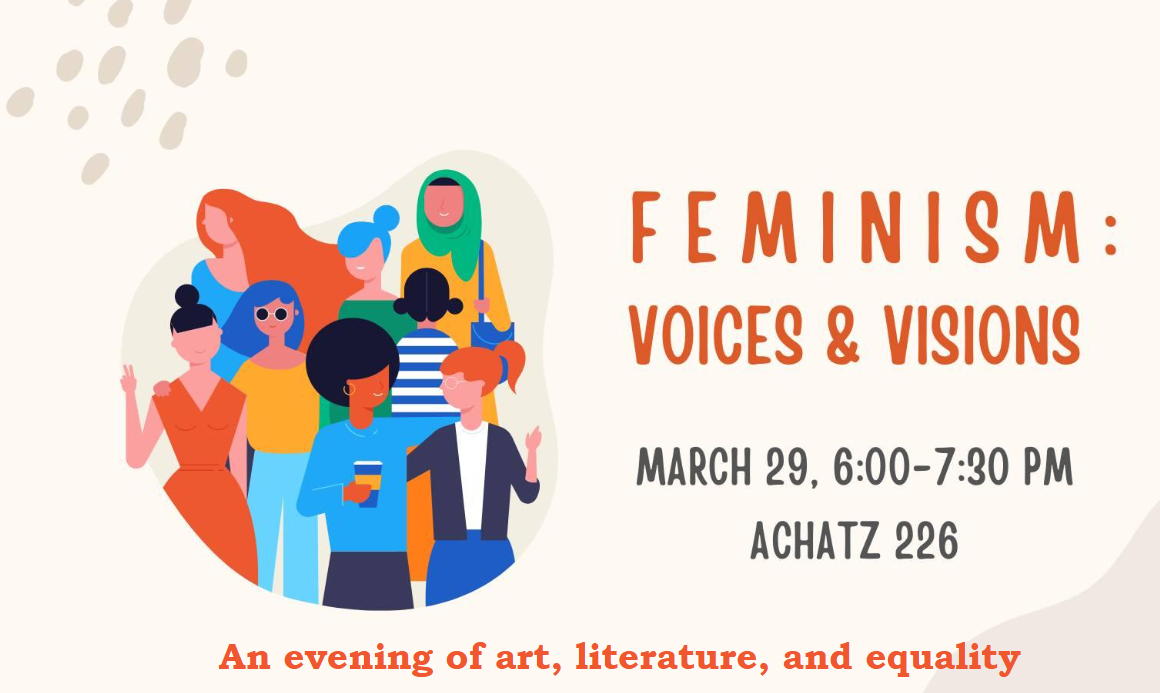
Welcome to Feminism: Voices and Visions, 2023. I’m Chelsie McCorkle, an Assistant Professor of English here at USF. This event is a long-standing tradition every spring to celebrate Women’s History month in March. This is my first year organizing this event, and I am honored to be taking this over from a long line of strong female mentors of mine. I want to thank all three of my predecessors for carving this path so that we can all share this evening together, discussing the issues, opportunities, and complexities that touch each of our lives. Tonight, as our very full program shows, there was no scarcity of interested faculty, staff, students, and community members to contribute to the success of the evening. My second thank you is to each of you for your willingness to contemplate and celebrate the work of feminist poets, artists, and ideas. But finally, I want to thank each of you for choosing to spend your evening here. We certainly cannot fix the problems that make feminist representation necessary tonight–but we can bring awareness and depth to the discussion of it. So, thank you all.
Gender equality is the idea that men, women, and non-binary individuals should have equal rights, opportunities, and treatment under the law and society. At its core, this is a simple idea. Feminism is an issue of human dignity. We are taught to reverence the unique dignity of each person on this campus. Every person has unique dignity, regardless of their gender identity or sex. So, why are evenings like this essential? Why is gender inequity a very real global concept in 2023?
Barriers like workplace discrimination, limited educational opportunities, unpaid care work, eating disorders and body image, and lack of political representation are very real. Intersectionality teaches us that racism, classism, ableism, and other forms of oppression intersect with gender to create unique experiences for different groups of women. While awareness of these barriers is important to understanding the conversation of feminism, one obstacle that is more manageable for us tonight is societal norms. Deep-rooted social norms and stereotypes about gender roles still exist. These norms and expectations can limit women's opportunities and contribute to gender inequality.
As Judith Butler writes in a 1988 essay, “Performing one’s gender wrong initiates a set of punishments both obvious and indirect, and performing it well provides the reassurance that there is an essentialism of gender identity after all.” This tension—the idea that there is a right way to be a woman, a right way to be the most essential woman—is ongoing and pervasive. It fails to reverence the unique dignity of different women who may define parts of themselves outside of these social norms.
These stereotypes for how to be the right type of women are deeply embedded in society. If I’m 10 lbs heavier, I am wrong. If I’m not married by a certain age, I have no value. If I unapologetically devote time to work life, I am not flexible enough. If I am unable or uninterested in bearing a child, I am unnatural. If I prioritize my mental health over nurturing someone else, I am selfish. If I am too assertive, I’m not feminine enough. If you were able to understand any of these norms, then we need to take ownership that our thoughts contribute to the larger problem. These stigmas, and so many more like them, exist. There is danger in believing that they don’t affect the decisions we make and how we treat others. These problems are aided by a lack of representation or voice–which is why we are here tonight.
This evening has been built to offer different types of stimuli–you will hear different voices as volunteers come up here to read feminist poetry. And we have an original student poem in Act II. You will see different visions of feminism as other volunteers share art and artist’s statements about that work. Behind each presenter, you will see slides with art that has been curated by our Art History professor, Dr. Beth Kuebler Wolf.
Embedded within each act, you will also hear from a featured presenter, using her own voice to bring context to specific ideas. In the first act, Chelsea Nabozny will be reading a part of a victim impact statement that speaks to the realities of sexual assault and represents empowerment through sharing our stories. In the second act, Heather Jeffries will speak about navigating gender inequity in male-dominated fields. While Erin McCarthy will speak to the great work our community engages in to bring about female empowerment in Act III.
Please use the QR code behind me or on the front of your programs to access a digital site that has the text of each poem for you to follow along with if you want. I am truly proud and excited to be sharing this evening with you all and celebrating our shared humanity and value for equality.