The following is adapted from a speech I gave at Voices of Feminism on March 25, 2026 in Fort Wayne, Indiana.
Welcome to Voices of Feminism 2026. My name is Chelsie Zuccollo, and I am the program director for Interdisciplinary Studies and teach English here at SF. We host this event every year in honor of Women’s History month.
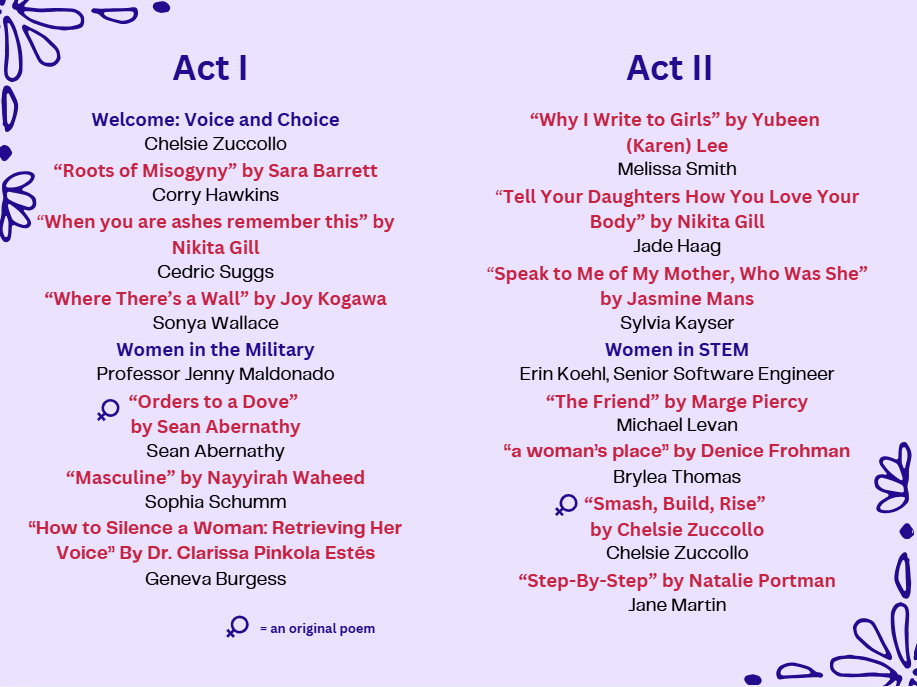
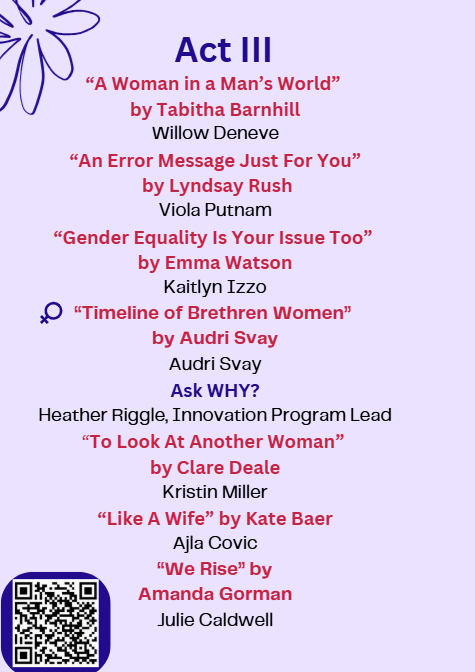
Tonight, you’ll hear voices—students and volunteers sharing feminist poetry, passages, and featured presentations. Behind them, you’ll see artwork curated by our own senior student, Sean Abernathy, who has helped bring this event to life. However you found your way here—curiosity, community, or extra credit—thank you for showing up.
Each year, when I stand here, I try to define feminism.
And each year, I fail. Because feminism isn’t something we finish defining.
It isn’t one belief, one moment, or one movement. It’s something we are still practicing.
It would be easier if the work were behind us instead of in front of us.
But we know it’s not.
We live in a world where progress and pushback exist at the same time.
Where the word “feminism” can mean empowerment to one person, and something uncomfortable—or even threatening—to another.
So instead of asking, “What is feminism?” I want to ask something different tonight:
What does it ask of us? I want you to think about Voice and Choice.
Have you ever replayed something you said five times in your head—
wondering if it was too much, too loud?
Have you ever known exactly what you wanted to say— and then said something smaller? Something safer?
Over time, we learn to edit ourselves. Not because we don’t have thoughts—
but because we’ve learned what can happen when we share them.
And here’s the part no one really says out loud: Having a voice is not the same as using it.
It doesn’t mean you won’t be interrupted. Dismissed. Or labeled.
And it definitely doesn’t mean you won’t second-guess yourself.
And choice—real choice—is more complicated than it sounds.
We are told we have choices. But those choices come with conditions. Pressure. Expectations.
If I speak directly, I risk being seen as too much.
If I soften my words, I risk not being heard at all.
If I prioritize my ambition, I am questioned.
If I prioritize others, I disappear.
If I use my voice, there may be consequences.
If I don’t, there is silence.
So it’s not just about having a voice or choice. It’s about feeling allowed to use your voice and refusing to shrink yourself.
Finding your voice isn’t a moment. It’s a decision you make over and over again.
My voice still shakes. But I’ve learned— a shaking voice is still a voice.
Feminism asks us to choose curiosity over defensiveness, and understanding over certainty.
And that can feel messy. So tonight is not about having all the answers. It’s about showing up.
It’s about listening– engaging. It’s about allowing ourselves to be moved—by art, by stories, by one another. Because feminism doesn’t grow in silence. It grows in conversation. In creativity. In community. And that’s what this space is for.
So tonight, I invite you not to just think about feminism— but to experience it. To notice what moves you—and what asks you to speak. Notice what lingers after tonight. That’s where the real conversation begins.